
Aquaponics Systems (Closed Loop)
A comprehensive master class in Aquaponic science. Unlike Recirculating Aquaculture Systems (RAS) which discard solid waste, or Hydroponics which relies on chemical synthetic mineral salts, Aquaponics integrates fish, plants, and nitrifying bacteria in a fully balanced recirculating ecosystem.
Interactive System Schematic Explorer
Click on any component below to explore the hydraulic and biological engineering details based on the physical design.
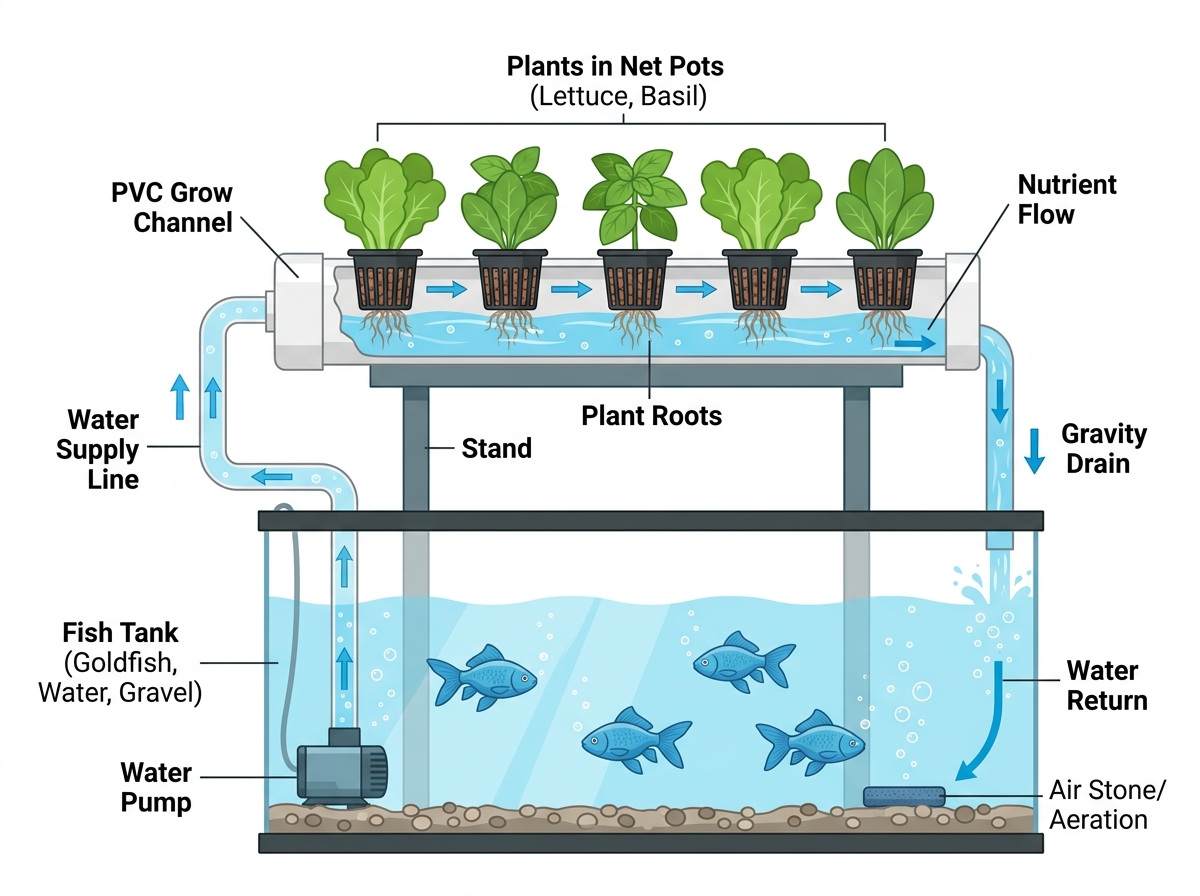
Fish Stock Tank & Biomass Engine
This is the primary habitat for your aquatic species. It serves as the reservoir of organic carbon, ammonia, and macro-nutrients. Proper sizing ensures stable temperature, chemical buffering, and safe oxygen thresholds.
For beginners, size the tank at a minimum of 500 Liters to maintain chemical stability. Keep stocking rates below 10-15 kg of fish per 1000 Liters.
Overstocking leads to rapid dissolved oxygen crashes, lethal ammonia spikes, and high physiological stress (fin rot, disease).
Perform weekly siphoning of bottom solid feces. Ensure tank walls are clear of toxic build-up and screen meshes are intact.
The Triple-Biological Symbiosis
The primary biological challenge in Aquaponics is managing three completely distinct organisms simultaneously: **fish**, **plants**, and **beneficial nitrifying micro-flora**. Each requires specific, conflicting environmental baselines. Successful operation requires continuous compromise.
While fish prefer slightly alkaline conditions, plants absorb nutrients most efficiently in acidic conditions. Nitrifying bacteria, the essential bridge converting toxic ammonia, require a slightly alkaline pH to carry out nitrification efficiently. Our designs focus on the strict compromise point (6.8 to 7.0 pH).
System Dynamics Core
In a closed-loop recirculating aquaponics layout, fish excrete Ammonia (NH3) directly. If ammonia rises above 0.5 mg/L, it causes internal bleeding, gill damage, and immediate death in fish. Nitrifying bacteria oxidize this ammonia into Nitrite (also highly toxic), then into Nitrate, which is safe for fish and is actively absorbed as organic fertilizer by the plants.
Ecosystem Highlights
Ultra Water Savings
Saves up to 95% of water compared to traditional soil farming. The only water loss is from plant transpiration and small evaporation cycles.
No Synthetic Nutrient Salts
Unlike hydroponics, nutrients are generated organically. Free of heavy sodium build-ups or chemical flushing requirements.
Pragmatic Biosecurity
Synthetic pest sprays or chemical fish treatments are forbidden (as they kill the opposite side of the loop), leading to naturally organic outputs.
Aquaponic Viral Ideas
Explore 20 viral ideas, plumbing walk-throughs, and biological siphon masterclasses.

DIY Auto Bell Siphon Hack in 60 seconds!
Watch a high-flow 3/4" standpipe bell siphon kick-start. Learn how an airtight dome and snorkel tube create instant suction vacuum.

Why pH 6.8 is the Magic Compromise point
Fish prefer 7.4+, plants prefer 5.8-, and nitrifying bacteria prefer 7.8+. We explain why 6.8 pH is the magic compromise number.

Coupled vs Decoupled loop explained simply
Stop returning crop runoff back to your fish! Decoupled loops let you feed plants custom organic supplements without poisoning your Tilapia.

How to Dose Chelated Iron Safely
Leaves turning yellow? It's iron chlorosis. Learn why you must use DTPA chelated iron below pH 7.0 and Fe-EDDHA for alkaline setups.

How a Radial Flow Filter removes heavy waste
Tired of fish poop clogging your lettuce roots? See how water enters a central baffle, letting heavy solids sink to the bottom cone instantly.

Kill Aphids organically inside your greenhouse!
Do not use chemical pesticides; they will kill your fish. Use Ladybugs or potassium bicarbonate sprays on leaves during twilight.

Commercial Aquaponics: Inside a 1-Acre Deep Water Culture Greenhouse
Tour a commercial lettuce and tilapia farm. Learn about continuous aeration, seedling transplantation, and professional harvesting workflows.

Step-by-Step DIY Aquaponics System for Beginners
Build a complete backyard IBC tank aquaponics system. Step-by-step plumbing, grow-bed media selection, and fish stocking density guidelines.

The Science of Nitrification in Aquaponic Filters
A deep dive into Nitrosomonas and Nitrobacter bacteria colony development. Understand how toxic ammonia converts to nitrite, and then to nitrate.

Tilapia Stocking Density Calculations Explained
How many fish can you safely keep per gallon? Learn how feeding rates, biofilter surface area, and oxygen levels limit fish biomass.

Best Crops for Aquaponics (And What to Avoid!)
From leafy greens like lettuce and mint to heavy feeders like tomatoes and cucumbers. Learn standard organic nutrient requirements.

How to Cycle an Aquaponic System Without Fish
Fishless cycling using pure ammonium chloride. Establish your nitrifying bacteria colony before introducing your expensive fingerlings.

Solids Filtration: Swirl Separators vs Radial Flow
Compare the efficiency of mechanical solid waste removal. See how settling velocity affects water clarity and biofilter health.

Buffer Up! How to Raise pH Safely in Aquaponics
Nitrification naturally lowers pH. Learn why you should use calcium hydroxide and potassium carbonate to buffer your system.

Vertical Grow Towers: Quadruple Your Aquaponic Yield
Maximize vertical space using modular zip-style towers. Perfect for strawberries and herbs in compact greenhouse environments.

Duckweed: The Ultimate Free Fish Food?
Grow duckweed using nutrient-rich aquaponic discharge water. Analyze its crude protein profile and see if it replaces pellets.

Troubleshooting Siphon Failure: Why Your Bell Won't Drain
Is your siphon trickling continuously instead of flushing? Fix common air leaks, adjust flow rates, and tune the snorkel tube.

Mineralization Tank Setup: Turn Poop Into Liquid Gold
Don't throw away filter solids! Learn how aerobic mineralization breaks down solid fish waste to release bio-available iron and phosphorus.

Red Wiggler Worms in Media Grow Beds
Why vermiponics is a game changer. How red wigglers consume solids, prevent anaerobic zones, and fertilize plant roots.

Greenhouse Aquaponics: Winter Heating on a Budget
Keep your Tilapia active and feeding during winter. Solar compost heating, thermal mass barrels, and double-walled polycarbonate hacks.
DIY Auto Bell Siphon Hack in 60 seconds!
Watch a high-flow 3/4" standpipe bell siphon kick-start. Learn how an airtight dome and snorkel tube create instant suction vacuum.
Why pH 6.8 is the Magic Compromise point
Fish prefer 7.4+, plants prefer 5.8-, and nitrifying bacteria prefer 7.8+. We explain why 6.8 pH is the magic compromise number.
Coupled vs Decoupled loop explained simply
Stop returning crop runoff back to your fish! Decoupled loops let you feed plants custom organic supplements without poisoning your Tilapia.
How to Dose Chelated Iron Safely
Leaves turning yellow? It's iron chlorosis. Learn why you must use DTPA chelated iron below pH 7.0 and Fe-EDDHA for alkaline setups.
How a Radial Flow Filter removes heavy waste
Tired of fish poop clogging your lettuce roots? See how water enters a central baffle, letting heavy solids sink to the bottom cone instantly.
Kill Aphids organically inside your greenhouse!
Do not use chemical pesticides; they will kill your fish. Use Ladybugs or potassium bicarbonate sprays on leaves during twilight.
Commercial Aquaponics: Inside a 1-Acre Deep Water Culture Greenhouse
Tour a commercial lettuce and tilapia farm. Learn about continuous aeration, seedling transplantation, and professional harvesting workflows.
Step-by-Step DIY Aquaponics System for Beginners
Build a complete backyard IBC tank aquaponics system. Step-by-step plumbing, grow-bed media selection, and fish stocking density guidelines.
The Science of Nitrification in Aquaponic Filters
A deep dive into Nitrosomonas and Nitrobacter bacteria colony development. Understand how toxic ammonia converts to nitrite, and then to nitrate.
Tilapia Stocking Density Calculations Explained
How many fish can you safely keep per gallon? Learn how feeding rates, biofilter surface area, and oxygen levels limit fish biomass.
Best Crops for Aquaponics (And What to Avoid!)
From leafy greens like lettuce and mint to heavy feeders like tomatoes and cucumbers. Learn standard organic nutrient requirements.
How to Cycle an Aquaponic System Without Fish
Fishless cycling using pure ammonium chloride. Establish your nitrifying bacteria colony before introducing your expensive fingerlings.
Solids Filtration: Swirl Separators vs Radial Flow
Compare the efficiency of mechanical solid waste removal. See how settling velocity affects water clarity and biofilter health.
Buffer Up! How to Raise pH Safely in Aquaponics
Nitrification naturally lowers pH. Learn why you should use calcium hydroxide and potassium carbonate to buffer your system.
Vertical Grow Towers: Quadruple Your Aquaponic Yield
Maximize vertical space using modular zip-style towers. Perfect for strawberries and herbs in compact greenhouse environments.
Duckweed: The Ultimate Free Fish Food?
Grow duckweed using nutrient-rich aquaponic discharge water. Analyze its crude protein profile and see if it replaces pellets.
Troubleshooting Siphon Failure: Why Your Bell Won't Drain
Is your siphon trickling continuously instead of flushing? Fix common air leaks, adjust flow rates, and tune the snorkel tube.
Mineralization Tank Setup: Turn Poop Into Liquid Gold
Don't throw away filter solids! Learn how aerobic mineralization breaks down solid fish waste to release bio-available iron and phosphorus.
Red Wiggler Worms in Media Grow Beds
Why vermiponics is a game changer. How red wigglers consume solids, prevent anaerobic zones, and fertilize plant roots.
Greenhouse Aquaponics: Winter Heating on a Budget
Keep your Tilapia active and feeding during winter. Solar compost heating, thermal mass barrels, and double-walled polycarbonate hacks.